- Trade Treasury Payments | The Liquidity Brief
- Posts
- TTP Liquidity Brief | Issue 50 - Trade routes, dollar roots
TTP Liquidity Brief | Issue 50 - Trade routes, dollar roots
Insights from Tbilisi’s digital trade push to why the dollar still dominates global finance.

Carter Hoffman
April 20, 2026
🌟 Editor's note
Editor’s Note | Week of 14 April 2026
By Carter Hoffman
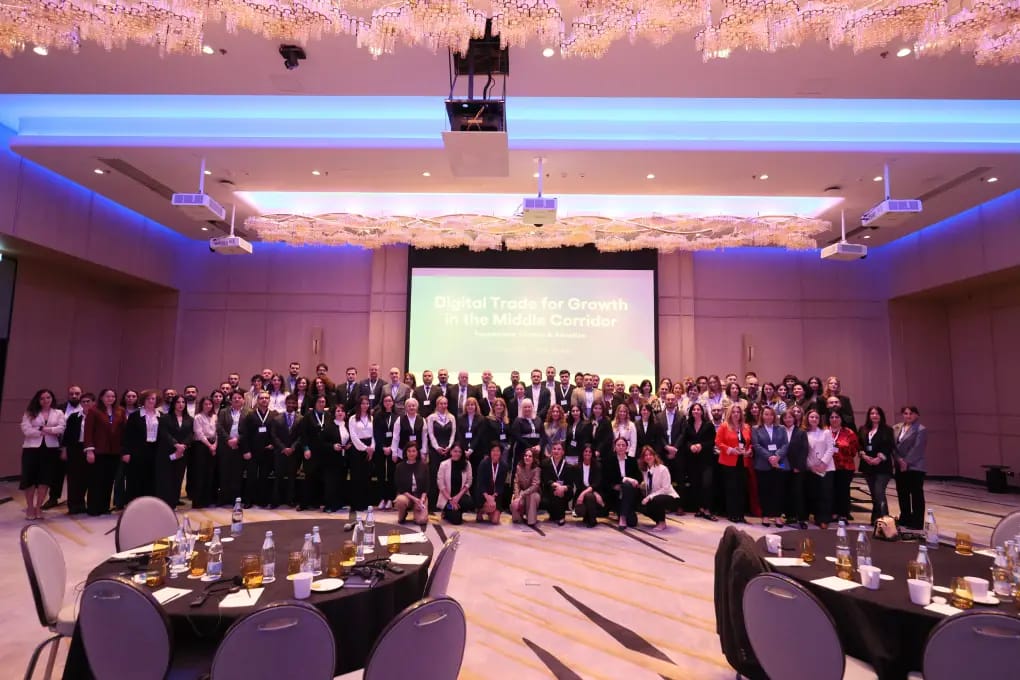
Touchdown in Tbilisi! The TTP team was on the ground in the Georgian capital last week for a few days of genuine conversation at the Digital Trade for Growth in the Middle Corridor Workshop.
The event, which was co-organised by EBRD, ADB, Bank of Georgia, ICC Digital Standards Initiative (DSI), ICC Georgia, TTP, and partners, brought together policymakers, banks, development institutions, and corporates in an invitation-only setting to discuss digital trade. As trade routes evolve, with central regions like the Middle Corridor becoming more heavily trafficked by trade flows, so too does the importance of the infrastructure, legal frameworks, and financial systems that support them. Keep your eyes out over the coming weeks as we release some of the insights we picked up from the workshop.
Back on the editorial side, we’ve been covering a wide range of developments this week. From trade flows and investment activity to tokenisation pilots, stablecoins in commodity markets, and the growing role of AI in banking, there is no shortage of change across the ecosystem.
As always, plenty to read and watch.
Until next time — keep connecting the dots.
— The TTP Editorial Team
Week Highlights
Georgia sits at a strategic crossroads of the Middle Corridor, strengthening its role as a key enabler of digital trade between Europe and Asia.

Digitalisation of trade and payments is becoming central to improving reliability and reducing friction along the corridor’s logistics chain.

The Middle Corridor is increasingly viewed as a vital route for faster, more efficient cross border trade and financial connectivity across Eurasia.

Regulatory clarity and coordinated frameworks are helping position Georgia as a more attractive hub for trade facilitation and investment.

Growing demand for streamlined digital infrastructure across the region is reinforcing Georgia’s role in supporting long term trade growth and integration.
Country of the Week: Georgia
Did you know that Georgia just might be the birthplace of wine? The country claims 8,000 years of winemaking history, making it one of the oldest wine cultures on earth. Even today, some wine is still made in clay jars (called ‘qvevri’) buried beneath the earth, where wine ferments much as it did 8 millennia ago.
Georgian trade stats (2024):
Total exports: $7.12 B | Total Imports: $18.1 B |
Largest export destination: Kyrgyzstan ($1.28 B) | Largest import partner: Turkey ($2.82 B) |
Largest Export: Cars ($2.39 B) | Largest Import: Cars ($3.53 B) |
Source: OEC
Slow Read
Global trade without the dollar? Not anytime soon
By: Armand Tannous, Tana Capital
Over the past year, renewed tariff measures, legal rulings affecting executive trade authority, and election-cycle uncertainty in the United States have yet again revived what has become a familiar question in global finance: can the dollar-centred trade system withstand political volatility in Washington?
For treasury teams and banks operating in emerging markets, it is a question that influences how they structure their correspondent banking relationships and secure cross-border liquidity in order to support clients engaged in international trade.
Yet in practice, most emerging market institutions are not seriously debating whether to move away from dollar settlement. In our work advising banks across Central Asia, the Middle East, and parts of Africa, the conversations tend to focus more on maintaining stable correspondent access, managing increasingly demanding compliance expectations from Tier-1 banks, and ensuring trade finance instruments can be issued and confirmed without disruption.
When you read between the lines, what that all shows is that the dollar’s role in global finance is underpinned by existing and well-entrenched infrastructure, not simply by policy that can be adjusted with the flick of a pen.
The dollar is still king
Despite recurring de-dollarisation headlines, the US dollar continues to dominate the international financial system by a wide margin. According to the IMF’s Currency Composition of Official Foreign Exchange Reserves (COFER), the dollar accounted for approximately 57% of disclosed global foreign exchange reserves as of the third quarter of 2025, compared with roughly 20% for the euro.
The same pattern is visible in market activity. The Bank for International Settlements’ 2022 Triennial Central Bank Survey, which is the most recent full survey available, shows the dollar being involved in close to 90% of global foreign-exchange transactions.
Payment flows tell a similar story. According to SWIFT’s Global Payments Data, the US dollar has consistently represented roughly 45%-48% of global cross-border payment value over the past decade. At the wholesale settlement level, the scale becomes even more striking. The CHIPS payment system, which processes large-value US dollar transactions between financial institutions, clears more than $2.2 trillion in payments each day.
When you consider all four of these figures together, it would be naïve to attribute them to simple market preference. Clearly, there is more behind it, and that is the depth of the liquidity ecosystem that exists behind the dollar.
Liquidity, not policy, drives dollar dominance
The United States remains home to the deepest capital markets in the world. The US Treasury market now exceeds $25 trillion in marketable securities outstanding, providing the benchmark asset and liquidity anchor for global financial institutions. Dollar-denominated money markets and repo facilities offer funding depth that few jurisdictions can compete with, let alone match.
Correspondent banking is one component of this broader ecosystem. Although often described as a payments mechanism, the role of correspondent banking is far more fundamental than that, as they provide banks, particularly those in emerging markets, with access to dollar funding and the ability to support trade finance issuance for clients engaged in international commerce.
That matters because trade finance is largely balance-sheet driven. While many of the instruments used today, such as letters of credit, standby guarantees, and documentary collections, depend on payment rails, they also depend on trusted counterparties, capital allocation, and enforceable legal frameworks. Faster settlement technology may be able to improve efficiency, but it cannot replace credit intermediation.
Speed is not the same as liquidity
Digital currencies and new payment technologies are often presented by central banks, fintech firms, and payments policymakers as alternatives to traditional settlement structures. According to the Bank for International Settlements’ latest CBDC survey, more than 130 jurisdictions are now exploring or developing central bank digital currencies.
Some of the underlying technology is advancing quickly. Project mBridge, for example, demonstrated that cross-border transfers and foreign exchange transactions can be completed in seconds rather than the several days often associated with traditional correspondent banking, according to BIS testing.
Those developments are significant. But we cannot confuse speed with liquidity.
A tokenised dollar is still a dollar. It is still anchored in the same US capital markets and funding system that supports today’s financial architecture. Regional digital currencies, by contrast, do not yet offer comparable funding depth or market liquidity. Faster rails may improve settlement mechanics, but they do not remove the balance-sheet demands of trade finance.
We don’t have to look too far back to see the implications of this playing out in the real world. During both the 2008 financial crisis and the 2020 pandemic-driven market disruption, global demand for dollar liquidity increased sharply. In response, the Federal Reserve expanded US dollar liquidity swap lines with major central banks to stabilise funding markets, showing how central dollar liquidity is to the global system.
The correspondent banking market itself has evolved in a similar direction. According to the BIS’s analysis of global correspondent banking trends, the number of correspondent banking relationships declined by roughly 25% between 2011 and 2022 as compliance requirements and regulatory expectations intensified.
Yet rather than dispersing global payment flows into alternative systems, this decline concentrated activity further among institutions operating within the deepest liquidity pools.
Now, let’s consider what this means for banks in emerging markets. While they may diversify their trade partners or explore local-currency settlement in certain bilateral corridors, and while digital infrastructure will continue to improve the speed and transparency of their cross-border payments, they will, in effect, remain tied to the US dollar system. When measured against liquidity depth, capital market scale, and the global acceptance of trade finance instruments, the dollar-based ecosystem has no comparable peer.
This certainly does not mean that the system is static. You don’t need to look any further than ISO 20022 migration, tokenisation initiatives, and the rise of digital settlement platforms to see that payment infrastructure is evolving and will continue to modernise how international transactions are processed.
But none of these advancements is likely to change, in the near term at least, the underlying US-dollar-based liquidity hierarchy that has been built up and solidified for decades.
Change will be gradual
Global trade depends on access to deep capital markets, reliable settlement infrastructure, and widely accepted funding currencies. On each of those measures, the dollar dominates.
Political developments may shape the headlines, but the architecture of global liquidity moves far more slowly.
For now, and likely for some time to come, the mechanics of international trade still run overwhelmingly through the US dollar.
Trade digest



IFC considers a $100 million trade finance line to support African trade
The International Finance Corporation (IFC) is considering a senior unsecured loan of up to $100 million to Ghana International Bank Plc (GHIB), a London-based bank specialising in trade finance and correspondent banking services for Africa.
The three-year facility includes a one-year grace period and will be disbursed in two equal tranches, with the second tranche contingent on full deployment of the first. The project is scheduled for IFC board consideration on 11th May 2026.
GHIB serves banks, corporations, and SMEs across Africa and acts as the collection agent for the Ghana Cocoa Board’s annual lending programme.
The financing aims to address Africa’s significant trade finance gap, estimated in the tens of billions annually, which limits the continent’s integration into global value chains.
Treasury, payment and global banking digest

Commodity traders turn to stablecoins as banking channels withdraw amid the US-Iran conflict
Heightened geopolitical tensions linked to the Iran conflict have prompted Western banks to reduce trade finance services for certain commodity flows due to rising compliance risks and sanctions exposure.
This retreat has contributed to a wave of “debanking,” leaving some commodity traders without access to essential banking services, particularly those involved in cross-border transactions related to affected regions.
Concerns over counterparty risk, including indirect ties to sanctioned Iranian entities, have led financial institutions to reassess risk appetite and withdraw from specific commodity trade finance activities.
Traders are increasingly seeking alternative settlement mechanisms to maintain liquidity and operational continuity amid tightening correspondent banking access.
Stablecoins, digital assets pegged to fiat currencies, are emerging as a practical solution by enabling near-instant cross-border transactions without reliance on traditional banking infrastructure.
The growing use of stablecoins in commodity trading signals a broader shift in global trade finance, accelerated by geopolitical instability and the need for resilient digital financial tools.
https://tradretreasurypayments.com/pulse
Foreign investors wary of India as FX curbs hit bonds and earnings risks haunt equities
India’s foreign exchange restrictions have increased hedging costs for overseas investors, making Indian bonds less attractive amid rising onshore one-year hedging costs of about 30 basis points and nearly 70 basis points offshore.
Liquidity in the offshore non-deliverable forward (NDF) market has thinned, complicating hedging and reducing returns for foreign bond investors.
India’s central bank, the Reserve Bank of India’s measures to stabilise the rupee that have coincided with surging oil prices due to the Iran conflict, which weighs on India’s economic outlook given its heavy dependence on Middle East oil imports.
Foreign investors have sold approximately 211 billion rupees (US$2.26 billion) of Indian government debt since late February, with outflows accelerating after FX curbs.
Equity investors have also retreated, with US$38 billion sold since early 2025 and record foreign outflows of US$12.7 billion in March alone, amid concerns over elevated valuations, AI disruption risks, and softening earnings momentum.
https://tradetreasurypayments.com/pulse
Oracle extends agentic AI platform to corporate banking
Oracle Financial Services has introduced embedded AI capabilities and pre-built AI agents for corporate banking functions, including treasury, trade finance, credit, and lending, automating mission-critical processes and accelerating decision-making.
The platform enables AI agents to engage directly with clients and bankers, transitioning banks from fragmented manual operations to unified, real-time, data-driven systems that enhance efficiency, compliance, and client experience.
Oracle’s next-generation banking platform powers AI orchestration through a robust agentic ecosystem, enabling seamless, tailored interactions with human oversight to ensure ethical governance and operational precision.
Key innovations include AI agents for corporate credit, such as Loan Data Extraction, Financial Data Extraction, Loan Data Validation, Documents Data Extraction, and Narrative Generation, which streamline data processing and credit analysis.
Trade and supply chain finance benefit from AI agents like Application Validator, which reviews bank guarantee applications for completeness and policy compliance, and SCF Program Creation, which automates supply chain finance program setup aligned with commercial contracts.
https://tradetreasurypayments.com/pulse
🗓️ Upcoming events
TTP x Sullivan Breakfast Club: Can we beat the fraudsters in our trade finance transactions?
| 2026 BAFT Global Annual Meeting
|
The 2026 Payments Canada SUMMIT
| Commodity Trading Week Europe
|
TXF Amsterdam 2026 – Global Natural Resources and Commodities Finance
| ITFA Americas 29th Annual Conference, Miami
|
ICISA 100th Anniversary
| Money 2020
|
EBRD 2026 Annual Meeting and Business Forum
| FCI 58th Annual Meeting
|
ICC Austria's Trade Finance Week 2026
|


